

As of April 6, 2025, the artificial intelligence landscape has shifted once again, this time with Meta’s bold unveiling of its latest Llama 4 family of models. Announced on April 5, 2025, and making waves across tech circles, Llama 4 represents a significant leap forward in open-source AI, challenging competitors like OpenAI, Google, and xAI while reinforcing Meta’s commitment to accessibility and innovation. At Ardent Lens, we’re diving deep into the details, data, and implications of this release, offering a clear, passionate perspective on why Llama 4 matters—and what it means for the future of AI.
The Launch: What’s New with Llama 4?
On Saturday, April 5, 2025, Meta introduced the first models in its Llama 4 series: Llama 4 Scout and Llama 4 Maverick, with a preview of the even more powerful Llama 4 Behemoth still in development. This launch, detailed across Meta’s blog, social media, and news outlets, marks a pivotal moment in the company’s aggressive push to dominate the generative AI space. Unlike previous iterations, Llama 4 is natively multimodal, meaning it can process and generate responses using not just text but also images and video, a feature that sets it apart from many rivals.
Meta CEO Mark Zuckerberg heralded the release in an Instagram video, emphasizing the company’s goal: “to build the world’s leading AI, open-source it, and make it universally accessible so everyone benefits.” The models are built on a cutting-edge “mixture of experts” (MoE) architecture, a technique inspired by Chinese AI startup DeepSeek, which allows different parts of the model to specialize in specific tasks, making them faster, more efficient, and cheaper to run.
Here’s what we know about the initial offerings:
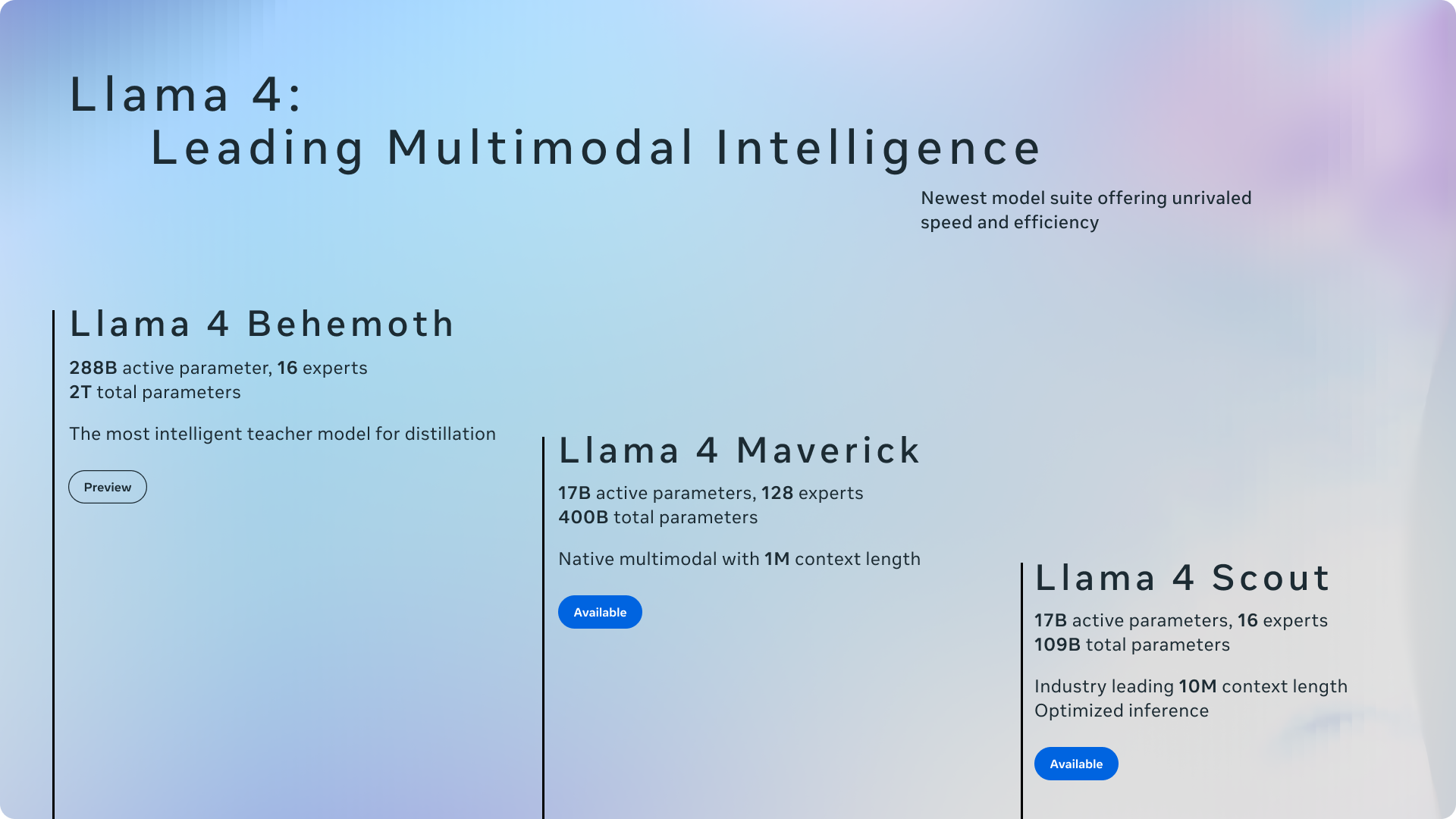
Llama 4 Scout: A 17-billion-active-parameter model with 16 experts and a total of 109 billion parameters. It’s designed to fit on a single NVIDIA H100 GPU, making it ideal for researchers and smaller enterprises. It boasts a staggering 10-million-token context window, enabling it to handle vast amounts of information at once—10 times larger than Google’s current models.
Llama 4 Maverick: Also with 17 billion active parameters but configured with 128 experts and 400 billion total parameters, Maverick is a “workhorse” model for general assistant and chat use cases. It excels in precise image understanding, creative writing, and multilingual tasks, outperforming competitors like OpenAI’s GPT-4o and Google’s Gemini 2.0 Flash in several benchmarks.
Llama 4 Behemoth: Still in training, this model is described as “one of the smartest LLMs in the world” and Meta’s most powerful yet. It’s intended to serve as a “teacher” for the other models, suggesting it could have upwards of 2 trillion parameters, a figure that dwarfs most existing models.
These models are available for download on Meta’s official Llama website and platforms like Hugging Face, reinforcing Meta’s commitment to open-source principles. They can also be accessed via Meta AI on WhatsApp, Messenger, Instagram Direct, and the Meta AI website, making them immediately usable for developers and everyday users.
The Numbers Behind the Hype
The scale of Meta’s investment and ambition is staggering. In January 2025, Zuckerberg revealed that Meta would spend between $60 billion and $65 billion this year to scale up its AI infrastructure, a figure that underscores the company’s all-in approach. This investment follows Llama’s rapid adoption, with the previous version surpassing one billion downloads just two weeks before the Llama 4 launch—up from 650 million in December 2024, according to Meta’s announcements.
Performance benchmarks, as shared in news reports and posts on X, show Llama 4 Maverick leading OpenAI’s GPT-4o and xAI’s Grok 3 on the LMarena leaderboard, placing second only to Google’s Gemini 2.5 Pro (Experimental). For instance, Maverick outperforms rivals in coding, reasoning, multilingual capabilities, long-context understanding, and image benchmarks, while Scout delivers superior results compared to Google’s Gemini 2.0 Flash Lite and xAI’s smaller models.
The 10-million-token context window is a standout feature, far surpassing the capabilities of most competitors. This allows Llama 4 to process entire books, long documents, or complex datasets in a single pass, a capability that could revolutionize applications in research, legal analysis, and content creation. Posts on X from tech enthusiasts and analysts suggest this could be a “game-changer” for open-source AI, with some calling it the “biggest leap yet” in the field.
Why It Matters: A Shift in the AI Race
Meta’s Llama 4 release is more than a technical upgrade—it’s a strategic move in the global AI arms race. The company is positioning itself as a leader in open-source AI, challenging the closed ecosystems of OpenAI and Google while capitalizing on the momentum of competitors like DeepSeek, whose innovations inspired Llama 4’s MoE architecture. This approach not only democratizes access to cutting-edge AI but also pressures rivals to accelerate their own development.
For tech companies, Llama 4 offers immediate benefits. It’s already integrated into platforms like Azure AI Foundry, Amazon SageMaker JumpStart, and Cloudflare’s Workers AI, allowing businesses to build multimodal applications without the high costs of proprietary models. Meta claims Llama 4’s efficiency—thanks to the MoE architecture—reduces computing power needs by up to 50% compared to traditional models, a claim supported by early tests shared on X and tech blogs.
The open-source nature also means smaller firms and researchers can innovate without licensing fees, a point Zuckerberg emphasized: “I’ve said for a while that open-source AI will lead the way, and with Llama 4, we’re starting to see that happen.” This could level the playing field, but it also raises questions about security, ethics, and control, as some posts on X express concerns about potential misuse of such powerful tools.
Challenges and Criticisms
Despite the hype, Llama 4 isn’t without its challenges. Some reports note that its multimodal features—while impressive—are currently limited to the United States and English-speaking users, with no timeline for global rollout. Posts on X suggest early adopters are struggling with deployment due to the models’ size, with Llama 4 Maverick requiring significant computational resources that smaller organizations might lack. Additionally, while Meta claims robust safety measures, including mitigations against adversarial attacks, skepticism remains about the long-term implications of open-sourcing such advanced technology.
Competitors aren’t standing still. OpenAI is reportedly working on its next-gen model, Grok, while Google continues to refine Gemini. Posts on X highlight a sentiment that Llama 4, while impressive, may face fierce competition, especially if rivals like xAI or DeepSeek release equally powerful models in the coming months.
The Human Angle: What This Means for Us
For the average person, Llama 4’s impact could be profound. Its ability to understand images, text, and video in a single model opens the door to smarter virtual assistants, more accurate search engines, and creative tools that blend media types seamlessly. Imagine asking your Meta AI assistant to analyze a photo of a street scene and generate a detailed report in seconds—or summarizing a 500-page document with pinpoint accuracy. These capabilities could transform how we interact with technology daily.
For developers and businesses, Llama 4 offers a cost-effective way to build next-gen applications, from customer service bots to content generation platforms. The open-source model also fosters a collaborative ecosystem, as seen in the rapid uptake of previous Llama versions, which amassed over a billion downloads in just two years.
However, the human cost is worth considering. As AI grows more powerful, concerns about job displacement, data privacy, and ethical use intensify. Meta’s investment of up to $65 billion in 2025 signals a future where AI could dominate entire industries, but it also raises questions about who benefits and who gets left behind.
Looking Ahead: The Road to LlamaCon and Beyond
Meta isn’t stopping with this release. The company has announced LlamaCon, set for April 29, 2025, where it plans to unveil more details about Llama 4 Behemoth and future roadmap. Posts on X and news articles speculate that Behemoth could push the boundaries of what’s possible, potentially rivaling or surpassing closed models like OpenAI’s o1 and xAI’s Grok 3 in reasoning and creativity.
For now, Llama 4 Scout and Maverick are available for developers to explore, with early feedback suggesting they’re among the most advanced open-source models yet. Whether Meta can maintain its lead in the AI race remains to be seen, but one thing is clear: with Llama 4, the company has set a new standard for innovation, accessibility, and ambition.
At Ardent Lens, we’ll keep watching this space, offering clear, passionate insights into how Llama 4 and other AI developments shape our world. Subscribe today to stay informed—and to see the future through our lens.