
Every so often, Ghana is handed a number so large that it does the thinking for us.
GHS73 billion.
It arrives not as data, but as verdict. It demands outrage before it invites scrutiny. And in that moment, something subtle happens. The question shifts from “Is this true?” to “How bad is this?”
But public finance does not work that way. It cannot.
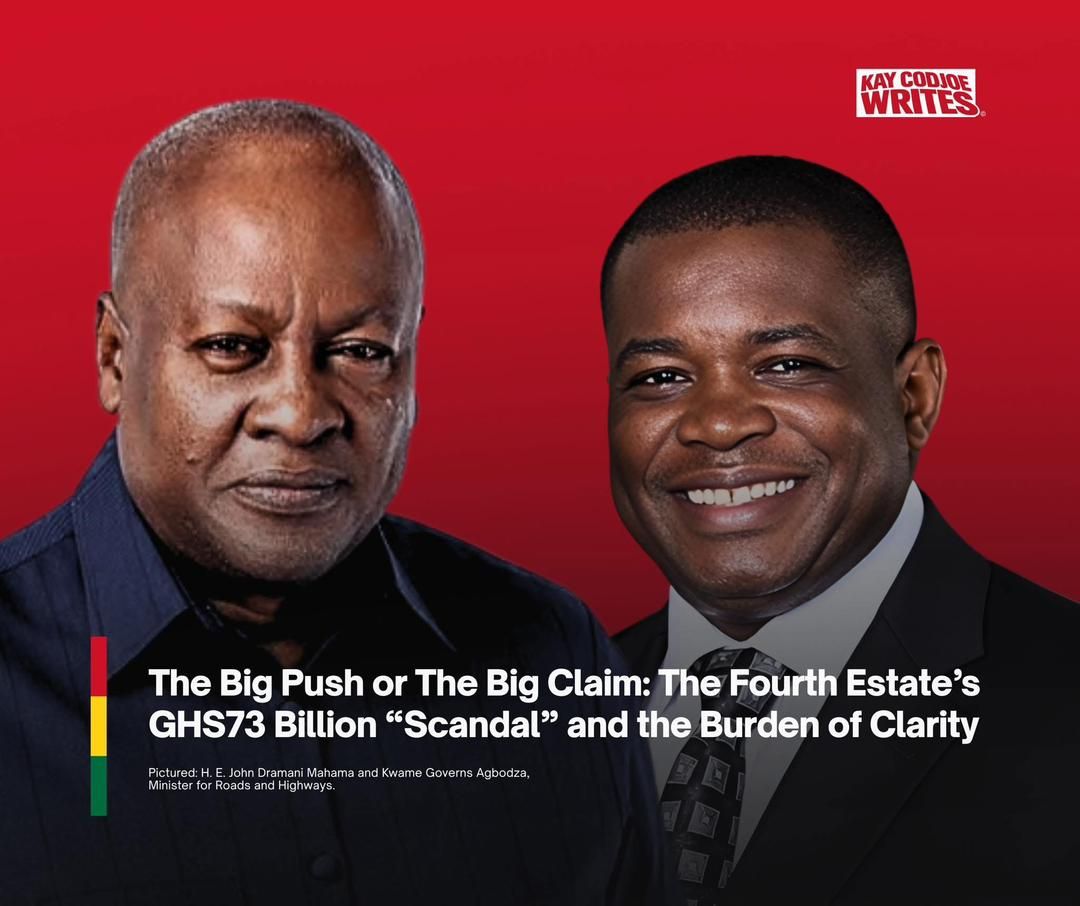
The Fourth Estate has placed before the country a serious allegation. That 81 road contracts, out of 107, were awarded through sole-sourcing within seven months under the Big Push programme led by Kwame Governs Agbodza, amounting to over GHS73 billion. If true, it would raise profound questions about procurement discipline, transparency, and the integrity of a flagship national programme.
But a claim of that magnitude must survive three tests: political, legal, and numerical.
On the political front, the ground is firm. President Mahama has been consistent in his public commitment to minimise single-source procurement. That is not in dispute. If the system has leaned heavily on non-competitive methods, then there is a clear tension between promise and practice. That tension deserves scrutiny.
But political contradiction is not legal breach.
The law does not ban single-source procurement. It permits it under defined conditions. It does not measure compliance by how many times the method is used, but by whether each instance is justified. That distinction is not academic. It is the entire point of the law.
Yet the article quietly replaces that standard with another. It suggests that volume alone proves violation. That if enough contracts are non-competitive, the system must be unlawful. That is not what the law says.
Then comes the deeper fracture, and this is where language stops being descriptive and starts being decisive.
Four different procurement methods have been collapsed into one accusation. It is within this collapse of distinctions that the confusion takes root.
Competitive tendering is open bidding. It is the benchmark. It is where price is discovered and transparency is visible.
Restricted tendering is limited competition. A shortlist is invited. There is still comparison, still a contest, even if controlled.
Single-source procurement is one supplier selected under legal justification. No competition, but permitted under defined conditions.
“Sole-sourcing” is not even a legal term. It is a public shorthand, often used to describe any non-competitive process, whether accurately or not.
When these distinctions collapse, analysis collapses with them.
The Minister maintains that procurement was largely through restricted tendering. The report insists it was predominantly sole-sourcing. If restricted tendering is being counted as sole-sourcing, the conclusion is exaggerated. If single-source procurement is being relabelled as restricted tendering, then the defence is weakened. Either way, the confusion of terms is not a minor error. It is the foundation of the entire narrative.
And then, the number.
GHS73 billion.
A number of this magnitude must come with a trail. This one does not.
No contract register. No approval trail. No breakdown. No audit path.
We are told it exists. We are not shown how it is constructed.
In public finance, numbers without traceability are not evidence. They are persuasion.
Ghanaians deserve accountability. But accountability must be built on evidence, not amplified by arithmetic.
None of this dismisses the concern. If competitive tendering has been sidelined, the country deserves answers. If exception-based procurement is becoming routine, that is a governance risk that must be confronted.
But concern is not proof. Pattern is not breach.
The Fourth Estate may be right. But if it is, the records will confirm it.
Until then, this is not yet a settled scandal. It is a serious allegation, amplified by a powerful number, still waiting for clarity, precision, and proof.
Because in the end, public discourse must answer to one discipline: clarity over noise, facts over framing.
A Big Push demands clarity. A Big Claim demands discipline. Ghana deserves both.