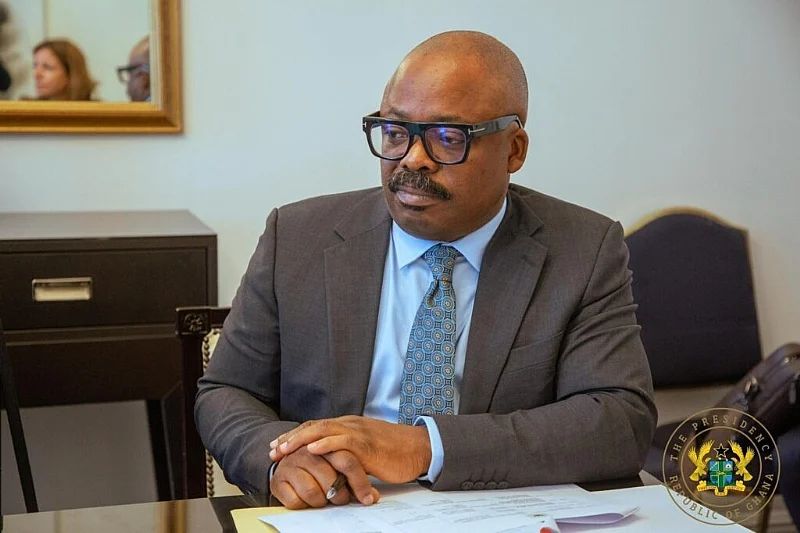

The Presidency has officially weighed in on the swirling public discourse surrounding President John Dramani Mahama’s use of a private jet owned by his brother for state business. In a recent analysis, the Executive Secretary to the President, Dr. Callistus Mahama, acknowledged that while the arrangement is born of practical necessity, the public’s concerns regarding potential conflicts of interest are entirely valid.
Dr. Mahama noted that the "Reset Agenda"—the President's current governing mandate—is built upon the foundation of public trust and institutional accountability. Consequently, the optics of presidential travel have become a focal point for Ghanaians demanding transparency in how state power and private resources intersect.
The Complexity of State Travels
While critics often suggest commercial flights or existing state assets as alternatives, Dr. Mahama highlighted several hurdles:
Operational Limitations: Many aircraft currently in the state fleet were not designed for the long-range, intercontinental missions required for modern diplomacy.
Security and Command: Presidential travel requires specialized communication and security protocols that allow the Head of State to exercise executive authority seamlessly, even while in transit.
The "Reset" Transition: Dr. Mahama emphasized that rebuilding state institutions and retooling the Ghana Armed Forces is a gradual process.
A Path Toward Self-Reliance
To resolve these temporary measures, Dr. Mahama revealed that a broader plan to re-equip the military is already in motion. He indicated that by November 2026, new aircraft are slated to join the presidential fleet. These state-owned assets will provide a permanent solution for the Head of State’s transportation, effectively ending the reliance on private or familial arrangements.
Ultimately, Dr. Mahama framed the current debate as a healthy sign of a functioning democracy, noting that the President remains deeply attentive to the "symbolism of leadership" and the necessity of maintaining moral clarity in public office.
Full Statement by Dr. Callistus Mahama
In recent days, a matter that might ordinarily have passed quietly through the machinery of state has become the subject of public conversation. Some Ghanaians have raised concerns about the use of an aircraft belonging to the President’s brother for official presidential travel. The most frequently expressed concern is whether such an arrangement could give rise to a perception of a conflict of interest.
It is a fair question. In a democratic society, citizens are not only entitled to ask such questions; they are duty-bound to do so. Public life is healthiest where scrutiny is vigorous and where those entrusted with authority remain conscious that trust is both earned and fragile. In that spirit, the concerns deserve reflection rather than dismissal.
Working closely with President John Dramani Mahama over the years, one becomes familiar with the quiet discipline that shapes many of his decisions—particularly the ones that attract little public attention. The President is acutely aware that leadership in Ghana today carries a particular burden: a demand not only for performance, but for moral clarity in the use of public power. That awareness has only deepened since he returned to office on a mandate anchored in what he called the Reset Agenda.
For that reason, this issue has not been taken lightly within the Presidency. What the public often sees is the aircraft taking off or landing. What is less visible is the difficult balance that must constantly be struck between practicality, security, cost, and national dignity when a President travels.
Presidential travel is unlike any other form of travel. It is not merely a journey from one city to another. It carries with it layers of responsibility—security protocols, diplomatic engagements, communication systems, and the simple but critical requirement that the Head of State remain able to function as the executive authority of the republic even while thousands of kilometres away from Accra.
In Ghana’s case, the challenge has been compounded by the current condition and limitations of the state’s available aircraft. Some of the platforms historically used for presidential or governmental travel were never originally acquired for long-range diplomatic missions. Others face technical and operational constraints that make certain journeys impractical or inadvisable.
Commercial travel, which some understandably suggest as a simple alternative, is also not always feasible for a sitting President—particularly when the travel involves long-haul intercontinental engagements or tightly scheduled diplomatic commitments. Beyond the obvious security considerations, such travel introduces logistical complexities that can make it difficult for a Head of State to carry out official duties during transit.
None of these realities erase the importance of public perception. And here lies the delicate point: even when a practical solution exists, leadership must remain attentive to how the public understands it.
In private moments, President Mahama often reflects on this tension. The Reset Agenda he campaigned on was not merely a programme of policies. It was also an appeal to rebuild public trust—trust that institutions will work, that leaders will act with restraint, and that governance will gradually move closer to citizens' expectations.
I recall a moment not long ago during preparations for an overseas engagement when the question of travel arrangements came up. The President listened quietly as officials outlined the available options—none of them perfect. After a long pause, he asked a simple question: “What is the safest and most responsible option for the country right now?” It was not a question about convenience or prestige; it was a question about responsibility.
On another occasion, during a long flight returning from an international summit, the President spent much of the journey discussing not the meetings he had just attended but the cost of governance and the need for restraint. “Public office must never become comfortable,” he said at one point. “The moment it does, you stop hearing the people.”
The public rarely sees these moments, yet they reveal how he approaches the burdens of leadership.
But resetting a system rarely happens overnight.
Many of the state institutions the President inherited—including key operational capacities within the security services—require rebuilding, re-equipping, and careful reform. The Ghana Armed Forces, which play an important role in state aviation, are part of that ongoing process of renewal.
Plans are already underway to strengthen Ghana’s presidential air transport capability as part of the broader retooling of the Armed Forces. By November this year, the country is expected to have additional aircraft within the presidential fleet, including one dedicated to the President’s travel.
When that happens, Ghana will once again have the capacity to rely fully on its own state assets for the safe and efficient transportation of the Head of State. It will also remove the need for the kind of temporary arrangements that have generated the current discussion.
It is worth remembering that an unusual familiarity with its limits has always shaped President Mahama’s relationship with public office. Having served as President before and experienced both the privileges and the political costs of leadership, he returned to office with fewer illusions than many leaders possess.
Those who interact with him daily will recognise a pattern in his thinking: an insistence that decisions be measured not only by immediate convenience but by their long-term implications for public trust.
He is also deeply conscious of the economic pressures facing ordinary Ghanaians. The cost of governance—including presidential travel—is something he frequently questions in internal discussions. In an era when citizens expect restraint from public officials, the symbolism of leadership matters as much as the substance.
This is why the President has repeatedly emphasised that the Reset Agenda must ultimately be judged not by slogans but by steady institutional improvement—sometimes visible, sometimes gradual.
Public patience, however, is never automatic. It must be earned.
Ghanaians have every right to expect clarity from those who lead them. They also have every right to question arrangements that appear unusual or unfamiliar. Yet it is equally important that national conversations allow room for context, for transition, and for the practical realities of governing a complex state.
The question before us, therefore, is not simply about an aircraft. It is about the broader challenge of rebuilding systems that should have been stronger in the first place.
In the months ahead, as the Armed Forces complete the retooling of Ghana’s state aviation capability and new aircraft enter service, the country will move closer to a more stable, self-reliant arrangement for presidential travel.
Until then, the conversation itself—sometimes uncomfortable, sometimes necessary—reminds us of something important: that the relationship between leadership and citizens is sustained not by silence but by engagement.
And if the Reset Agenda means anything at all, it must mean exactly that.
Ardent Lens Take
The conversation surrounding the President's use of a private family asset is a classic study in the tension between operational pragmatism and political symbolism. While Dr. Callistus Mahama effectively argues the logistical necessity—citing the specialized requirements of executive command and the current limitations of Ghana’s aging state fleet—he rightly identifies that in the realm of governance, perception often functions as reality.
In a "Reset" climate, where the administration’s brand is anchored in institutional renewal and fiscal restraint, the optics of familial dependency can inadvertently signal a blurred line between private interest and public duty. The true "lens" here isn't just focused on the aircraft itself, but on the speed of transition. By setting a definitive horizon for the arrival of new state assets in late 2026, the Presidency has moved to transform a current ethical friction point into a measurable benchmark for the Ghana Armed Forces' retooling. Until those wheels touch the tarmac, the administration must navigate a narrow corridor where every flight is scrutinized not just for its destination, but for the trust it carries in its cargo.